

Led a strategic revamp of lead flow email programs for Consolidated Credit U.S., redesigning engagement-focused email journeys across four company brands to improve user interaction and conversion. This initiative drove a 15% increase in inbound calls and an 8% lift in enrollments by optimizing messaging, timing, and user pathways.
Applied the same proven email optimization framework to Debt.com, Consolidated Credit Canada, and Lighthouse, resulting in a 21% increase in calls and a 16% increase in enrollments. All initiatives were executed through the PostUp email platform, leveraging advanced segmentation, delivery optimization, and performance tracking to maximize campaign performance.
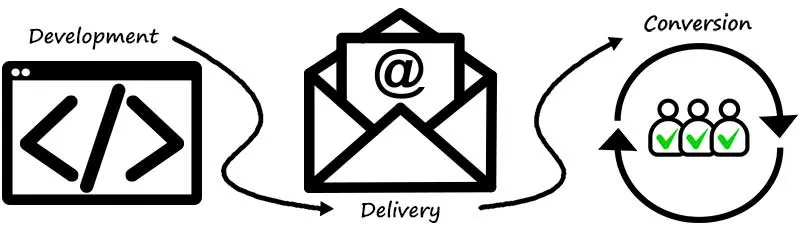
Email brand and design initiatives for Debt.com, Consolidated Credit U.S., and Consolidated Credit Canada focused on delivering consistent, trust-driven email experiences while respecting each brand’s unique voice and audience. Designs emphasized responsive layouts and conversion-focused messaging to support lead nurturing, increase engagement, and Conversions.
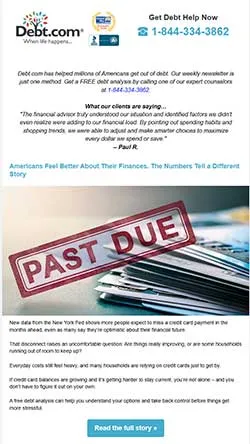


Email compatibility and optimization require building clean, responsive HTML that renders consistently across major email clients, including Gmail, Outlook, Yahoo, Apple Mail, and mobile apps. This includes using table-based layouts, inline CSS, and client-safe components, along with careful testing and troubleshooting for common rendering differences (such as Outlook’s Word-based HTML engine).
Email compatibility and optimization require building clean, responsive HTML that renders consistently across major email clients, including Gmail, Outlook, Yahoo, Apple Mail, and mobile apps. This includes using table-based layouts, inline CSS, and client-safe components, along with careful testing and troubleshooting for common rendering differences (such as Outlook’s Word-based HTML engine).
A/B testing for email template design compares multiple layout and visual variations to measure engagement and conversion performance. By testing elements such as layout structure, imagery, color usage, and call-to-action placement, design decisions are guided by real user behavior, enabling continuous optimization of email templates for improved performance and consistency across audiences and devices.
Debt.com
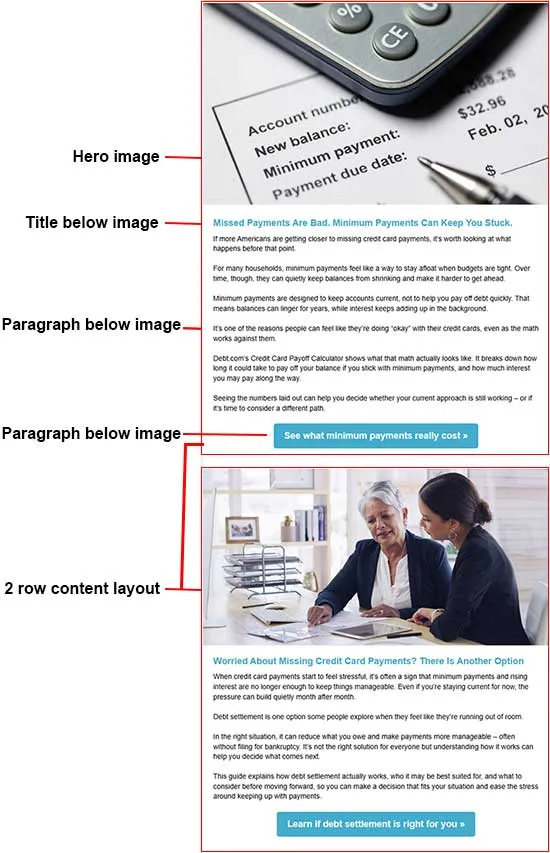
A/B testing revealed that Debt.com achieved higher engagement with a hero-driven layout and expanded content.
Consolidated Credit
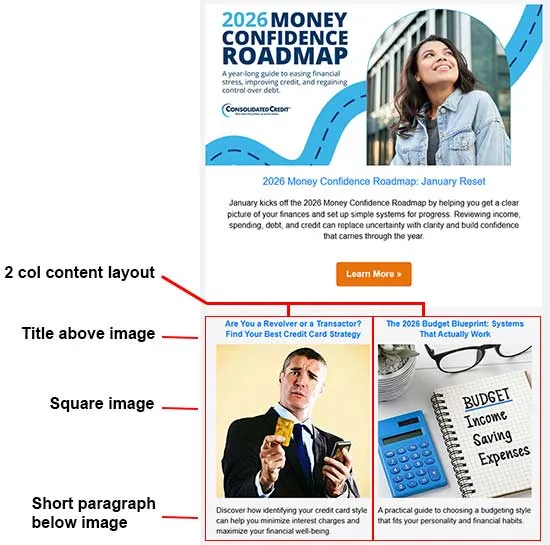
A/B testing analysis showed that Consolidated Credit achieved stronger engagement with a two-module content layout, allowing users to scan and interact with multiple value propositions more effectively than a single hero-image content block.